
India's economy is projected to maintain growth above 7 per cent in 2026-27 (FY27), supported by strong domestic consumption and investment, even as global growth faces risks from geopolitical tensions, according to industry body Assocham.

Calling such reports baseless, Finance Minister Nirmala Sitharaman said there was no such move under consideration.

The Indian government has refuted claims of fuel shortages, asserting that the country possesses approximately 60 days of fuel stock cover and that all petrol pumps are adequately stocked and operating normally.

10 stocks from the Nifty 200 index that offer good growth potential and scope to deliver decent returns from current levels, based on brokerage estimates.

It is time for India to step up and get Russia, China and Europe to agree to a joint appeal to all combatants. Time is of essence, tomorrow may be too late, asserts Colonel Anil A Athale, former head of the history division, ministry of defence.
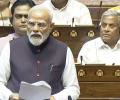
Prime Minister Narendra Modi addresses the Rajya Sabha, detailing India's strategies to navigate the global energy crisis sparked by the West Asia conflict, including securing diverse energy sources and expanding strategic oil reserves.

'The problem is not just slower growth, but also the quality of growth.'

'Our diplomacy should have been focused on preventing war and avoiding the inevitable disruptions it would cause, posing a real risk to India's growth story,' asserts former foreign secretary Shyam Saran.

Brent crude oil prices can touch $150 a barrel (bbl) - up a whopping 103 per cent from the current levels - in the worst-case scenario if the Israel-Iran geopolitical tensions escalate, suggest analysts.

Households should moderate large discretionary expenses for the time being.
'They should prioritise essential spending. They should maintain an emergency fund covering 6 to 12 months of expenses.'
'The immediate impact for India will be very minimal as the share of Venezuela in our total overseas production is very low.'
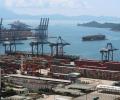
With the Iran war escalating sharply and crisis deepening in the global energy market, India on Monday unveiled a coordinated plan to support exporters and shippers caught in the fallout.

Indian OMCs have not been buying Iranian or Venezuelan crude which is actually sanctioned by US. OMCs have always complied with the price cap of $60 for Russian oil recommended by the US.

Sensex and Nifty post steepest weekly loss in over a year, falling nearly 3 per cent.

The clock on the ceasefire is running out. But everyone's already whispering about round two, possibly as soon as this weekend.

The 'rescue' operation occurred within kilometres of Iran's underground tunnel complex at Isfahan, assessed by the IAEA and US intelligence as holding a substantial portion of the country's 60 per cent enriched uranium stockpile. Retired senior US military officers have highlighted that the mission's footprint -- hundreds of special operators, multiple heavy-lift aircraft deep inside Iran -- appears outsized for recovering a single airman. Prem Panicker continues his must read blog on the Iran War.

Re-instatement of 5% custom duty on crude imports will help.

The cost of the war is being counted not in the corridors of power in Washington or Tehran, but in Firozabad's darkened furnace rooms, Howrah's idle casting sheds, and a barbershop in Kochi where the wait is suddenly, inexplicably, an hour long, notes Prem Panicker in his must read blog on the Iran War.

Sanctioning Russian oil would have led to a sharp surge in oil prices to above $80 per barrel levels, which would impact pump prices in the US ahead of midterm elections next year.

There are hopes of a turnaround in overall corporate earnings after six quarters of single digit growth.

The question is whether the clocks allow enough time for two deeply mistrustful sides to get there, and whether the surface calm holds long enough for the paddling to produce something before the ceasefire ends on April 22, notes Prem Panicker in his must read blog on the Iran War.

Iran is fighting a different war: Older, slower, and in some ways more dangerous. Iran doesn't need to shoot down an F/A-18. It only needs to make the Strait of Hormuz feel dangerous long enough for insurance markets, shipping companies, and oil futures traders to do the rest. Prem Panicker continues his must-read daily blog on the war in the Middle East.

Alliances fight wars effectively only when they share an endgame. If Israel acted without US knowledge, then the military alliance is operating without real coordination at the level of strategic targeting. Neither picture is reassuring in a war that is no longer regional in its consequences. Prem Panicker continues his must read daily blog on the Gulf War.

Opposition parties are demanding a full Parliament discussion on the West Asia conflict, criticising the government's silence and calling for a contingency plan to protect India's energy security and citizens.

Delhi should keep all its options open in what is essentially a transitional period in the geopolitics of energy rather than remain a gatekeeper serving Trump's 'America First', suggests Ambasssador M K Bhadrakumar.

While investors would focus on the results and guidance for the third quarter of financial year 2025-26 (Q3FY26) in the normal course of business, the US-Israeli attack on Iran and the latter's retaliation at Gulf allies of the US has forced them to weigh the consequences of the event.

Egypt, Pakistan, Saudi Arabia and Turkey met in Islamabad in what analysts say is the formal opening of a new diplomatic formation that could reshape the post-war regional order. Their immediate goal is a ceasefire; their larger ambition is to ensure that neither Iran nor Israel emerges from this war in a dominant position. Pakistan's foreign minister then flew directly to Beijing and mooted a Chinese role as guarantor of any eventual agreement. Prem Panicker continues his must read daily blog on the Gulf War.

When missiles fly in this region, they are never just aimed at military targets.

By all available indications, the White House drafted a face-saving note and handed it, ready-made, to Islamabad. Pakistani Prime Minister Shehbaz Sharif was supposed to then post it in the guise of a plea urging Trump to extend the deadline by two weeks 'to allow diplomacy to run its course'. Trump would then graciously accept Pakistan's 'request' and declare a ceasefire. Sharif dutifully posted the message on X. Except that he, or whoever was handling the account, forgot to delete the tell-tale first line visible in the edit history: 'Draft - Pakistan's PM Message on X'. Prem Panicker's must read blog on the Iran War.

The US Department of the Treasury on Wednesday imposed sanctions on Russia's two largest oil companies, Rosneft and Lukoil, in an effort to pressure the Kremlin to end its war in Ukraine.

The United States, which entered this war in expectation of a short, sharp win along the Venezuela model, is now preparing for deeper involvement in a conflict it does not fully control, without the allies it typically relies on, against an adversary that is not behaving as expected, in a global environment that is already absorbing economic shock. Prem Panicker continues his must read daily blog on the Gulf War.

'Based on the joint statement, a formal agreement will be drafted, which may take a month or month-and-a-half to finalise. We aim to sign the formal agreement by mid-March.'

Israel and the United States had a plan. Iran punched back. And now the Gulf is reeling, the world is beginning to feel the pain and, as on date, no one in Washington or Tel Aviv appears willing to admit that the punch has landed, notes Prem Panicker, continuing his must-read blog on the war in the Middle East.

When everyone has footage and no one can verify it, the loudest voice wins, notes Prem Panicker who begins a daily blog on the War in the Middle East.
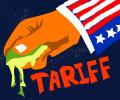
US President Donald Trump on Wednesday slapped an additional 25 per cent tariff on goods coming from India as penalty for New Delhi's continued buying of Russian oil.

The question is no longer whether the war will expand. It has. The next few days will tell us whether the war stabilises around Hormuz or whether the Strait itself becomes the trigger for a far larger rupture. What to watch for over the next 48 hours is simple: Any move by the US toward direct naval control of the Strait; any credible Iranian attempt to disrupt or mine shipping lanes and, critically, whether energy infrastructure in the Gulf continues to be targeted.If those lines are crossed in tandem, the war will no longer be containable within the region.

The US said India will lower tariffs on a "vast array" of American industrial and agricultural goods, such as "fruits, vegetables", to zero per cent under the trade deal announced by President Donald Trump.

New Delhi will substantially reduce tariffs on industrial and agricultural goods while continuing to protect sensitive sectors. Tariffs on some agricultural products that are not traditionally considered sensitive will be brought down to zero, while in the case of relatively sensitive items, duties will be reduced in a graded manner and quotas will be imposed.

In a veiled attack on US President Donald Trump, Canada's Minister of Energy and Natural Resources Tim Hodgson on Tuesday said India's free trade agreement with the European Union is a "perfect" answer to global hegemons that use tariffs and economic integration as tools of coercion.

Finance Minister Nirmala Sitharaman's biggest challenge will be to find a new growth driver, particularly against the backdrop of a global economy ravaged by heightened uncertainty and fragmentation, financial markets on a precipice, and global commodity prices on a continued uptrend.
